Renaissance & Baroque
The Renaissance did not merely revive classical forms — it theorized architecture for the first time, producing Alberti's treatise, Palladio's Quattro Libri, and the mathematical rules of perspective that transformed how buildings were both designed and represented. Baroque took those rational bones and clothed them in theatrical drama.
Brunelleschi, 1436
The Italian Renaissance
Humanism in Stone · 1420–1600
Filippo Brunelleschi's dome over Florence Cathedral (1420–1436) was the engineering miracle of the Renaissance: a double-shell octagonal dome 44 meters wide, built without centering (a temporary wooden support frame) by inventing a new herringbone brick-laying system. His discovery of linear perspective simultaneously transformed architecture's representation.
Palladio's Four Books of Architecture (1570) codified the proportional system from which Georgian, Federal, and Neoclassical architecture worldwide would descend. The Villa Rotonda — four identical pedimented porticos, a central dome — became the most imitated building in architectural history.
Baroque Architecture
Divine Drama · 1600–1750
If the Renaissance was rationalist, the Baroque was theatrical. Architecture became an instrument of persuasion — a weapon of the Counter-Reformation designed to overwhelm the senses and induce religious awe. Gian Lorenzo Bernini's colonnade at St. Peter's (1656–1667) is a masterpiece of spatial manipulation: 284 columns forming an embracing oval that funnels the viewer toward the basilica's facade.
Baroque architects bent the straight line, curved the wall, dissolved the boundary between architecture, sculpture, and painting. Light became a compositional element: the lantern above a dome would project a single theatrical shaft into the interior's staged darkness.
 Mughal
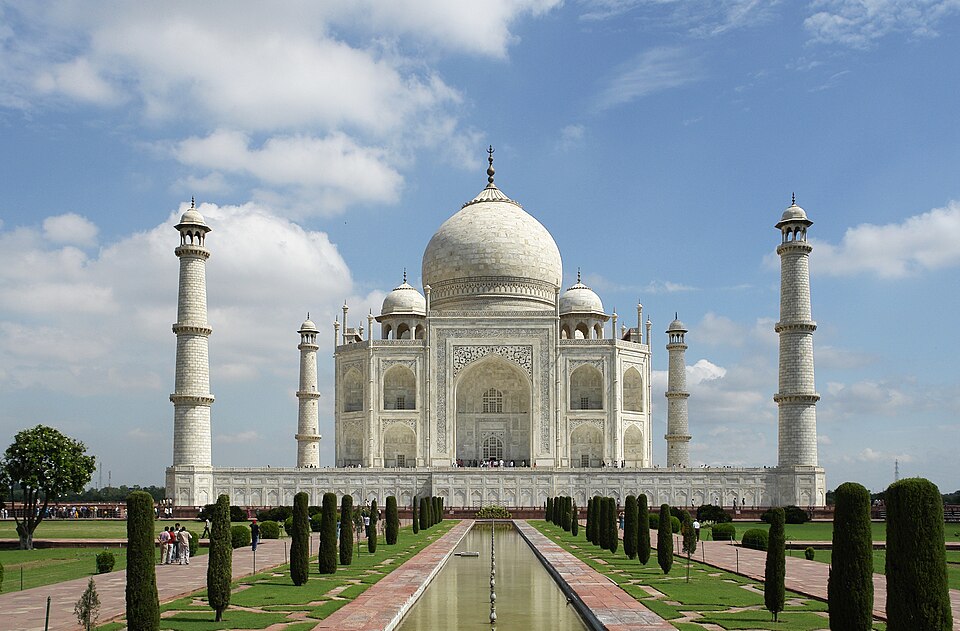
The Taj Mahal
Mughal Synthesis · 1632–1653 · Agra, India
Shah Jahan's mausoleum for his wife Mumtaz Mahal synthesizes Persian, Islamic, Central Asian, and Indian architectural traditions into a perfectly proportioned whole. White Makrana marble inlaid with semi-precious stones — pietra dura — creates floral arabesque patterns of breathtaking delicacy. The marble changes color through the day, from pink at dawn to brilliant white at noon to golden in moonlight.
The entire complex — mosque, guesthouse, caravanserai, forecourt, and the famous reflecting pool — is designed on axes of perfect symmetry. 20,000 workers labored 21 years on its construction.
Palace of Versailles
Absolute Monarchy in Stone · 1661–1710 · France
Louis XIV transformed a hunting lodge into the largest palace in the world — and moved the entire French government into it. Versailles is architecture as political propaganda: its 2,000+ rooms, 67-meter Hall of Mirrors, and 800-hectare formal gardens express royal power through sheer overwhelming scale and the control of nature itself.
Architect Jules Hardouin-Mansart's facades in French Classicism — alternating flat pilasters with arched windows — established the grammar of grand public architecture that spread across Europe. The garden by Le Nôtre imposes geometric rationality on the landscape for kilometers.