Modern Architecture
The industrial revolution forced a question that architecture had never faced: what should a building look like when its structure is no longer stone or timber but iron, steel, and reinforced concrete? The answers — Modernism, the International Style, Brutalism, Postmodernism, Parametricism — define our built world today.
Frank Lloyd Wright
Organic Architecture
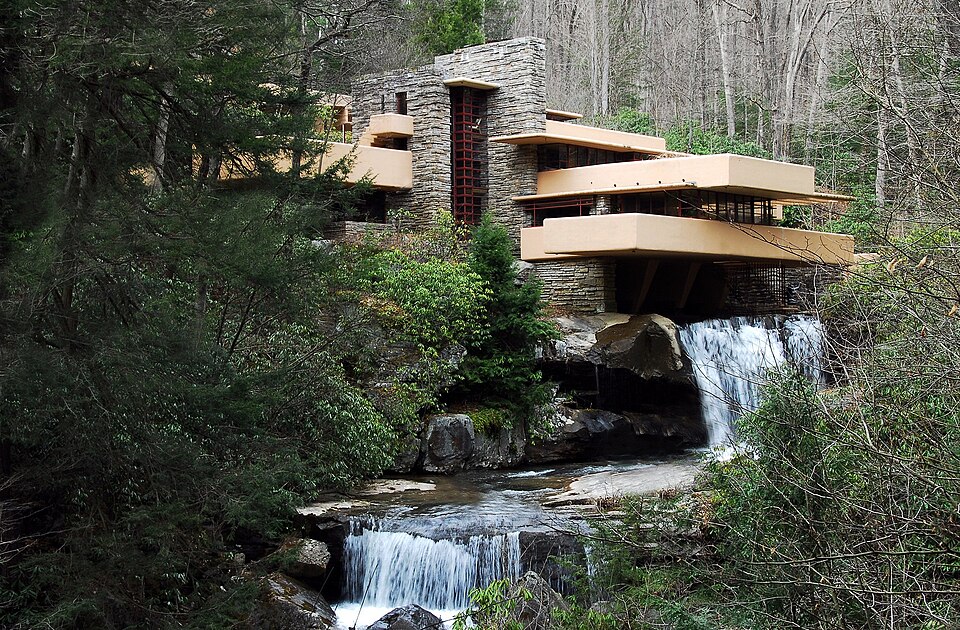
Wright believed architecture should emerge from and belong to its natural site. Fallingwater (1935–39) — cantilevered concrete trays hovering above a waterfall — remains the most famous private home ever built. His "Prairie Style" homes extended horizontally into the Midwestern landscape with low rooflines and open plans that dissolved interior/exterior boundaries.
Le Corbusier
The Machine for Living
Le Corbusier's Five Points of Architecture — pilotis (stilts), free plan, free facade, horizontal windows, roof garden — were a manifesto for the machine age. His Unité d'Habitation in Marseille (1952) stacked an entire neighborhood vertically: 337 apartments, a rooftop nursery, gymnasium, and shops in a single concrete slab lifted on massive pilotis.
Mies van der Rohe
Less is More
Mies stripped architecture to its structural essence. The Barcelona Pavilion (1929) — eight chrome-sheathed cruciform columns supporting a thin marble roof slab, walls of polished onyx and green Tinian marble — made minimalism the most sophisticated possible statement. The Seagram Building in New York (1958) defined the glass-and-steel skyscraper vocabulary still dominant today.
Louis Sullivan
Form Follows Function
Louis Sullivan invented the skyscraper as a building type, reasoning through how a tall steel-framed commercial building should look. His solution — three-part vertical composition of base, shaft, and capital, mirroring a classical column — gave the skyscraper an architectural logic. His rich terra-cotta ornament, derived from natural forms, showed that functional buildings could be intensely beautiful.
Walter Gropius
The Bauhaus School
Walter Gropius founded the Bauhaus in 1919 with the conviction that fine art and industrial craft must be reunited. The Dessau Bauhaus building (1926) — glass curtain wall revealing the workshop block's structural frame, flat roofs, no historical ornament — became the canonical image of Modernism. The school's influence on graphic design, furniture, typography, and architecture still permeates every designed object today.
Zaha Hadid
Parametric Deconstructivism
Zaha Hadid reimagined architecture as fluid, dynamic, and continuous — a landscape rather than a box. Using computational design tools unavailable to earlier architects, her buildings fold, curve, and flow across site boundaries. The Heydar Aliyev Center in Baku appears to rise organically from the surrounding plaza, its white fiberglass skin undulating without a single straight line or right angle.