Sacred Architecture
No building type has generated greater architectural ambition than the house of god. Across every faith tradition, builders reached for height, light, and complexity to express the divine — and in doing so invented the technologies and forms that defined entire civilizations.
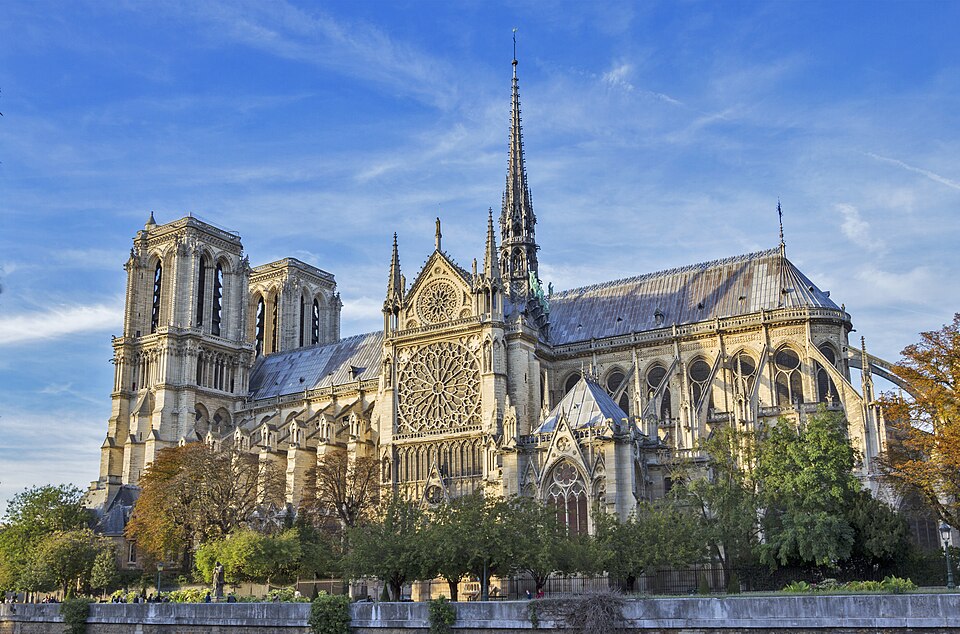
Gothic Cathedrals
Gothic architecture is a structural argument: every element conspires to direct the thrust of a stone vault outward and downward, so that the wall between the piers can dissolve into colored glass. The flying buttress — a skeleton of stone arched away from the nave wall — was the key invention, allowing walls to rise to unprecedented heights while admitting floods of light.
Notre-Dame de Paris (begun 1163), Chartres, Reims, and Cologne Cathedral represent this tradition at its peak. The pointed arch, rib vault, and rose window — circular tracery of stone and jeweled glass — became the visual language of Christian Europe for 400 years.
- Pointed arches distribute thrust more efficiently than round arches
- Flying buttresses: external arched supports that absorb lateral force
- Stained glass: narrative Bible for an illiterate population
- Cologne Cathedral: 632 years to complete (1248–1880)
- Notre-Dame nave vault: 33 meters above the floor
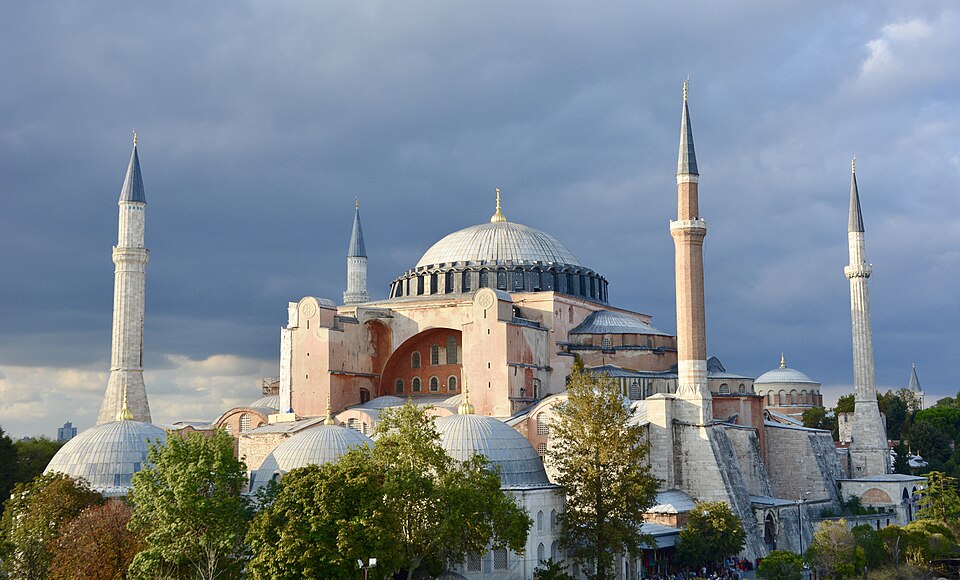
Hagia Sophia & Byzantine Genius
When Emperor Justinian's architects Anthemius and Isidore completed Hagia Sophia in 537 CE — in just five years — contemporaries believed it was built by angels. Its central dome, 31 meters wide and rising 56 meters above the floor, appears to float: a ring of 40 windows at its base creates a halo of light that makes the structure's mass invisible.
Byzantine architecture solved the problem of placing a round dome over a square space through the pendentive — a curved triangular surface that transitions from the square piers below to the circular drum above. This invention would define Islamic and Eastern Orthodox architecture for the next 1,500 years.
- Pendentives: the key structural innovation of Byzantine architecture
- Interior gold mosaic: 1,000+ years of accumulated decoration
- Main dome: 31m diameter, 56m above floor — floated for 1,000 years as world's largest
- Four minarets added 1453–1574 after Ottoman conquest
Islamic Architecture
Geometry as Theology · 7th Century CE – Present
Islamic architecture transformed the structural into the metaphysical. The prohibition on figural representation channeled creative energy into abstract geometry — fractal patterns that repeat at every scale from city plan to tile — expressing the infinite through mathematical rigor.
The Great Mosque of Córdoba (784–987 CE) features a forest of 856 columns supporting a double tier of horseshoe arches in alternating red brick and pale stone. The Alhambra's Nasrid Palaces demonstrate muqarnas — stalactite-like vaulting that dissolves ceiling into an infinite honeycomb. The minaret called the faithful to prayer; the qibla wall and mihrab directed them toward Mecca.
 Hindu-Buddhist
Hindu Temple Architecture
Mountain of the Gods · 3rd Century CE – Present
Hindu temple architecture is cosmology in stone: the central tower (shikhara in north India, vimana in the south) represents Mount Meru, the cosmic mountain at the center of the universe. The temple is a three-dimensional mandala — a sacred diagram — and the worshipper's movement through its spaces is a ritual journey toward the divine presence in the garbhagriha, the womb-chamber at the summit.
Angkor Wat (c. 1150 CE), the world's largest religious monument, extends the temple-mountain concept across 200 hectares. Its five towers arranged in a quincunx (like dice's five-spot) represent Meru's five peaks; the surrounding moat is the cosmic ocean.